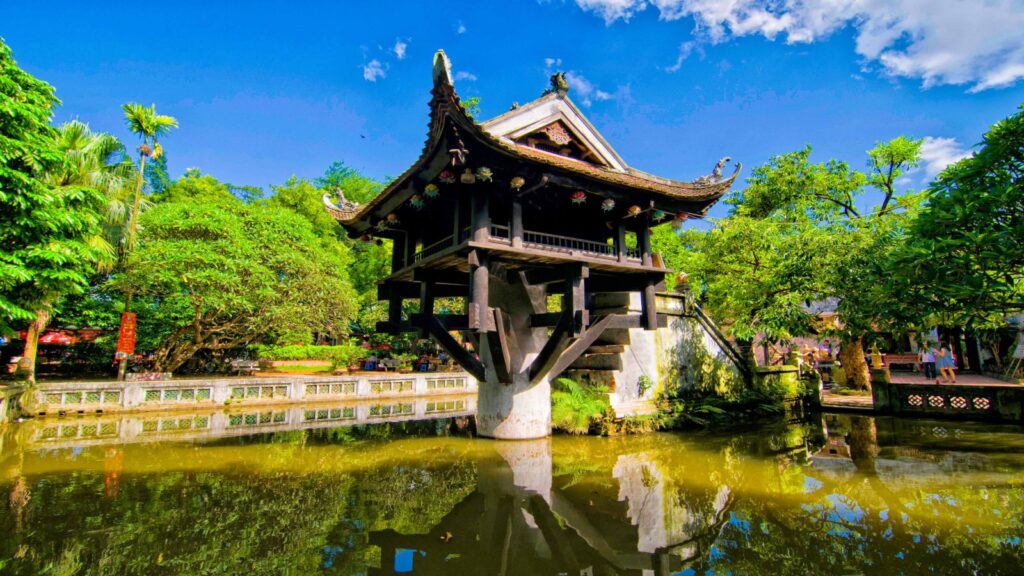


One Pillar Pagoda
The One Pillar Pagoda (Chùa Một Cột), officially named Diên Hựu Tự (meaning “Long-Lasting Happiness Pagoda”), is one of Vietnam’s most iconic historic and architectural landmarks. Situated in the Ba Dinh District of Hanoi adjacent to the Ho Chi Minh Mausoleum complex this unique 11th-century Buddhist shrine stands alongside the Perfume Pagoda as a core symbol of traditional Vietnamese Buddhist culture and imperial identity.
- Historical Foundation and Legend
The pagoda was commissioned in 1049 CE under the reign of Emperor Lý Thái Tông, the second monarch of the Ly Dynasty, which catalyzed the golden age of Buddhism in Vietnam.
- The Dream: Heirless and aging, Emperor Lý Thái Tông had a vivid night dream in which Avalokitesvara (Quan Âm, the Goddess of Mercy) was seated upon a glowing lotus blossom in a square pond, handing him a male infant.
- The Construction: Shortly thereafter, the Emperor married a young peasant woman who bore him a crown prince. In deep gratitude, and under the advisory of the monk Thiền Tuệ, the Emperor ordered the construction of a pagoda designed to mimic the exact visual of his dream: a singular shrine rising directly out of a lotus pond.
- Architectural Design and Symbolism
The One Pillar Pagoda represents a peak example of early Vietnamese timber engineering, demonstrating a sophisticated system of interlocking joints without the extensive use of metal nails.
The Lotus Metaphor
The structure is built to visually represent a single lotus flower blooming out of the water, a fundamental symbol of purity, enlightenment, and detachment in Buddhist philosophy.
Key Technical Layout
- The Pillar: The entire shrine rests on a single vertical column. Historically, this was a massive trunk of a single tree. The modern replacement consists of two interlocking cylinders of reinforced stone/concrete, standing approximately 4 meters tall and boasting a diameter of 1.2 meters.
- The Lien Hoa Dai (Lotus Station): Perched atop the pillar is a small, square wooden pavilion measuring 3 meters by 3 meters. It is supported by an intricate, radial network of 8 wooden struts that securely brace the overhanging floorboards against the central column.
- The Roofline: The curved, four-sided tiled roof features elegant upswept corners and is crowned by the traditional motif of “two dragons flanking the moon” (lưỡng long chầu nguyệt), symbolizing protective cosmic harmony and imperial authority.
- Destruction, Reconstruction, and Modern Continuity
The pagoda standing in Hanoi today is a faithful reconstruction, as the original structure fell victim to geopolitics during the mid-20th century.
- Historic Enhancements: In 1105, Emperor Lý Nhân Tông expanded the site, adding the Linh Chieu pond and surrounding it with gilded balustrades, transforming it into a major imperial ritual center where the court held annual Buddha-bathing ceremonies.
- The 1954 Destruction: Following the Battle of Dien Bien Phu, as French colonial forces prepared to withdraw from Hanoi in October 1954, extremist elements mined and dynamited the One Pillar Pagoda, reducing the wooden shrine to splinters and cracking the original stone column.
- Post-Colonial Restoration: The newly formed government of the Democratic Republic of Vietnam prioritized its immediate salvage. Architect Nguyễn Bá Lăng meticulously drafted restoration blueprints based on historical archives, allowing the site to be completely rebuilt and reopened in 1955.
- Destination and Itinerary Integration
From a destination management perspective, the One Pillar Pagoda is rarely treated as a standalone stop. Because of its compact physical footprint, it operates as an essential, high-density inclusion within broader historic walking tours of Hanoi’s political core.
Logistical Highlights
- Circuit Sequencing: It is positioned immediately adjacent to the Ho Chi Minh Mausoleum, the Ho Chi Minh Museum, and the Presidential Palace Stilt House. Standard half-day city itineraries route guests smoothly through the Mausoleum grounds before concluding at the pagoda.
- Cultural Practices: The shrine remains an active place of worship. Local residents and visitors regularly climb the stone stairs to pray for fertility, health, and family longevity before the statue of Avalokitesvara housed inside the pavilion.