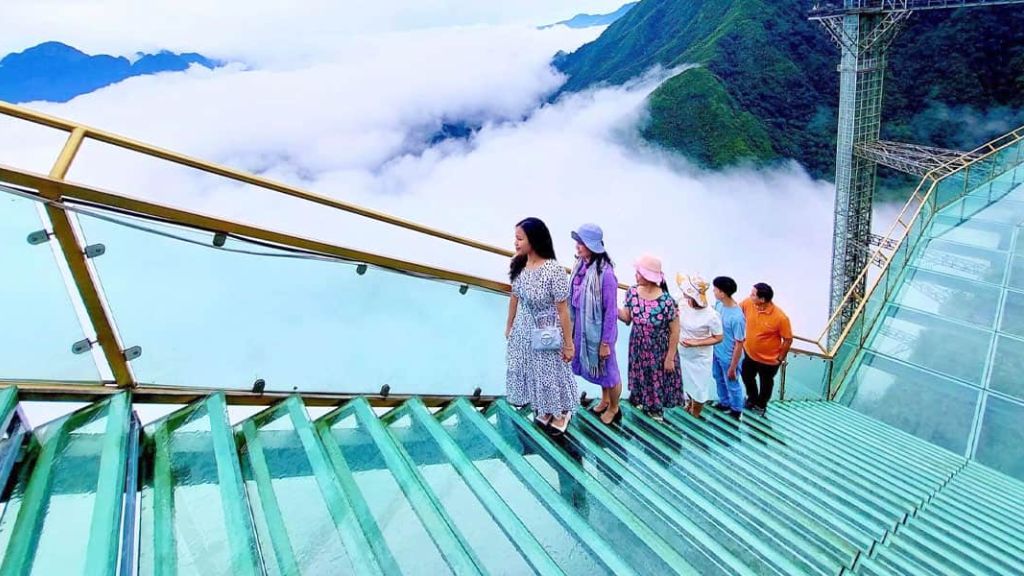


Rong May Glass Bridge
The Rồng Mây Glass Bridge (Cầu kính Rồng Mây, translating to “Dragon in the Cloud”) is an architectural and adventure tourism landmark located in northwestern Vietnam. Officially opened in late 2019, it stands as one of the highest and most visually striking glass bridge structures in Southeast Asia, acting as a major anchor destination for travelers exploring the Lào Cai and Lai Châu provincial corridors.
- Geographical Location and Accessibility
While frequently marketed within the Sapa tourism ecosystem due to its proximity, the bridge is geographically situated in Tam Đường District, Lai Châu Province.
It spans the historic Ô Quy Hồ Pass—one of the “Four Great Mountain Passes” of northern Vietnam.
- Proximity: The site is roughly 17 to 20 kilometers west of Sapa town center.
- Topography: It is built directly into the sheer limestone cliffs of the Hoang Lien Son mountain range, looking out across sweeping alpine canyons and the winding mountain highway below.
- 2. Engineering and Technical Specifications
The construction of Rồng Mây represents a significant civil engineering achievement given the remote terrain, high wind velocities, and seismic considerations of the sub-alpine zone.
The Glass Elevator (Thang máy lồng kính)
Before stepping onto the bridge, visitors ascend via a massive external vertical elevator shaft built flush against the cliff face.
- Height: The transparent glass elevator stands 300 meters tall.
- Function: It transports passengers from the reception area up through the mountain canyon to the main bridge platform in roughly 90 seconds, providing 360-degree panoramic views during the ascent.
The Bridge Structure
- Total Elevation: The walkway sits at an absolute altitude of approximately 2,200 meters above sea level, with a direct drop of over 300 to 500 meters to the valley floor below.
- Dimensions: The main glass walkway extends 60 meters outward from the cliffside edge and stretches 300 meters along the mountain face.
- Material Composition: The walking surface is constructed from three primary layers of ultra-clear tempered glass bonded together with high-strength PVB (Polyvinyl Butyral) intermolecular adhesive films. The total glass thickness exceeds 7 centimeters, designed to handle an active load capacity of several hundred visitors simultaneously while safely resisting local wind storms and temperature shifts.
- The Integrated Adventure Ecosystem
The Rồng Mây resort complex has expanded significantly beyond the main glass walkway to capture the high-yield adventure tourism market. It features a tiered variety of activities:
- The Glass Path Walkway: The standard experience allows visitors to walk entirely around the mountain facade on transparent panels, offering unrestricted bird’s-eye views of the Ô Quy Hồ Pass.
- The Suspension Bridge (Cầu Độc Mộc): For a more physical challenge, a separate wooden-plank suspension bridge runs parallel to the cliff face, requiring safety harnesses as guests navigate spaced steps over the open chasm.
- Ziplining and Bungee Jumping: The extreme drops have permitted the installation of high-speed ziplines spanning the canyon walls and dedicated platforms for controlled bungee drops.
- Operational Considerations and Microclimates
From a tour coordination perspective, Rồng Mây requires careful timing due to the distinct weather patterns of the Hoang Lien Son range:
The Cloud Phenomenon
The name “Dragon in the Cloud” is literal. Due to the high altitude and moisture movement over the pass, the bridge is frequently engulfed in thick mountain fog and fast-moving sea-of-cloud formations.
Ideal Seasonal Windows
- Clear Views (September to November / March to May): These transitional months offer the highest probability of crisp, clear days with deep valley visibility.
- Cloud Hunting (December to February): The winter season brings low temperatures and heavy condensation, creating the dramatic “cloud ocean” effects directly beneath the glass floor, though it reduces distance visibility.
- Strategic Positioning in Regional Itineraries
Rồng Mây functions as an excellent complement to traditional Sapa itineraries (such as Fansipan Peak or local ethnic village trekking). Because it takes roughly 2 to 3 hours to fully experience the elevator, bridge, and surrounding viewing platforms, it is ideally integrated as a half-day excursion. It is frequently paired logistically with a stop at the Ô Quy Hồ viewpoint to catch the sunset over the Lai Châu valley.