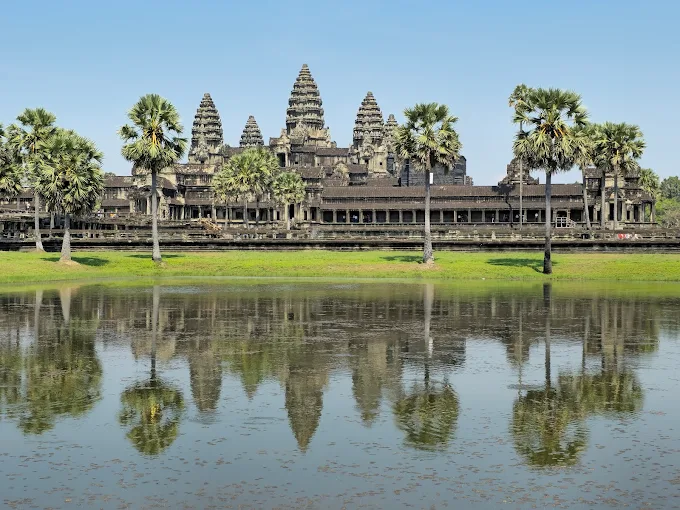


Angkor Wat Temple
As the crown jewel of the ancient Khmer Empire, Angkor Wat is not just the most famous temple in Cambodia; it is the largest religious monument in the world. Built in the first half of the 12th century (roughly between 1113 and 1150 AD) under the direction of King Suryavarman II, it stands as the absolute pinnacle of classical Khmer architecture and art.
Unlike most other temples in the region, Angkor Wat was never entirely abandoned to the jungle. Its massive, water filled moat provided a natural defense barrier, allowing it to remain an active center of worship for centuries.
Symbolic Design: A Model of the Universe
Angkor Wat is a masterclass in sacred geography. It is designed as a physical, three dimensional representation of Hindu cosmology, acting as a miniature replica of the universe. The architectural components mirror the layers of the cosmos:
- The Central Towers: The five lotus bud towers symbolize the five peaks of Mount Meru, the sacred home of the Gods in Hindu and Buddhist mythology. The towering central peak rises 65 meters above the ground.
- The Enclosures: The concentric rings of courtyards and galleries represent the mountain ranges surrounding the sacred peak.
- The Moat: A massive, 200 meters wide rectangular moat encloses the 400-acre site, symbolizing the mythical oceans at the edge of the universe. Beyond its deep religious symbolism, this engineering marvel stabilizes the temple’s foundations by maintaining consistent groundwater levels year-round.
The Enigma of the Westward Orientation
While almost every other major temple in Angkor faces east to greet the rising sun, Angkor Wat uniquely faces west. This intentional deviation has fascinated historians for centuries and carries two main theories:
- A Tribute to Vishnu: Suryavarman II dedicated Angkor Wat to the Hindu deity Vishnu, breaking away from the Shiva worship of his predecessors. Because Vishnu is traditionally associated with the western quadrant of the compass, the temple’s orientation honors him.
- A Royal Mausoleum: In Hindu tradition, the west is the direction of the setting sun and is associated with death and the afterlife. Because of this, scholars believe Suryavarman II intended Angkor Wat to serve as his funerary state temple and final resting place. This theory is heavily supported by the temple’s bas-reliefs, which read counter-clockwise (the direction of traditional Hindu funeral rituals) rather than the standard clockwise progression.
Masterpieces on the Walls: Bas-Reliefs and Apsaras
Every inch of stone at Angkor Wat seems to tell a story. The temple features nearly 1,200 square meters of exquisitely carved bas-reliefs lining the outer galleries of the first level.
The Churning of the Ocean of Milk
The most celebrated gallery depicts this classic Hindu creation myth. It features 88 gods (devas) on one side and 92 demons (asuras) on the other, engaged in a cosmic tug-of-war using the giant serpent King Vasuki wrapped around Mount Mandara. Together, they churn the cosmic ocean to extract the elixir of immortality (amrita).
The Divine Dancers (Apsaras and Devatas)
Carved directly into the pillars, walls, and niches of every level are more than 1,700 unique celestial nymphs (apsaras) and guardian spirits (devatas).
Look Closely: No two carvings are identical. Early 20th century catalogs meticulously documented the staggering variety of intricate hairstyles, jewelry, traditional skirts (sampots), and facial expressions, offering a vivid glimpse into the royal court fashion of the 12th century Khmer Empire.
The Transition to Buddhism
While Angkor Wat began as a grand Hindu sanctuary, the religious landscape of Cambodia shifted toward the end of the 13th century. The empire gradually embraced Theravada Buddhism, and Angkor Wat smoothly transitioned into a Buddhist shrine.
Inside the central sanctuary (the third level, known as the Bakan), the original statues of Vishnu were eventually walled in or replaced by standing Buddha figures, a spiritual transformation that preserved the temple’s status as a sacred pilgrimage site right up to the modern era. To explore more facets of this ancient monument: Discover the best viewing points for sunrise and sunset. Examine the engineering behind how the temple was built.