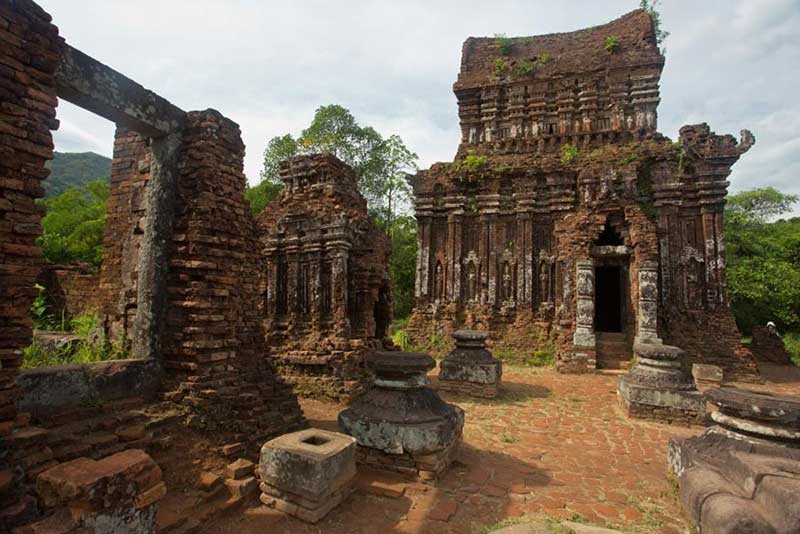


Oc Eo Ancient City
The ancient city of Óc Eo (located in the modern-day Thoại Sơn District of An Giang Province, Vietnam) stands as one of the most significant archaeological landscapes in Southeast Asia. Flourishing primarily between the 1st and 7th centuries CE, Óc Eo was the principal economic engine and premier port city of the Funan Kingdom—a powerful, maritime-oriented polity that dominated the Mekong Delta and controlled vital segments of the maritime Silk Road.
The site is currently in the international evaluation phase for UNESCO World Heritage status, following Vietnam’s official submission of its nomination dossier.
- Historical & Geographical Context
Óc Eo was intentionally situated within a low-lying, seasonally flooded coastal plain of the Mekong Delta, roughly 15 kilometers inland from the Gulf of Thailand. Rather than a limitation, the ancient residents transformed this watery environment into a massive logistical advantage.
The urban core was longitudinally and transversely bisected by a highly sophisticated network of man-made canals. These waterways served a dual purpose:
- Water Management & Agriculture: They drained the saline-heavy marshlands, mitigated seasonal monsoonal floods, and permitted intensive wet-rice cultivation.
- Geopolitical Connectivity: A primary, 68-kilometer-long canal directly linked the coastal port of Óc Eo to the inland political capital of Angkor Borei (in modern-day Takeo Province, Cambodia), creating a highly integrated socio-economic heartland.
- Archaeological Discovery & Stratigraphy
The site was first systematically brought to light in 1944 by the French archaeologist Louis Malleret, who utilized aerial photography to identify the geometric outlines of the ancient city and its canals beneath the delta’s sediment layers. Malleret famously hypothesized that Óc Eo was Cattigara, the easternmost port city documented by the Roman geographer Claudius Ptolemy in the 2nd century CE.
Modern excavations split the development of Óc Eo into clear chronological phases:
Phase | Timeline | Structural & Cultural Characteristics |
Pre-Óc Eo | 3rd Century BCE – 1st Century CE | Initial iron-age settlements, early interactions with regional maritime travelers. |
Early Óc Eo | 1st – 3rd Century CE | Emergence of structural embankments, pile-supported stilt dwellings, and localized spice processing. |
Typical / Peak Óc Eo | 4th – 7th Century CE | Massive institutionalization. Construction of large brick and stone religious monuments, deep internationalization of trade, and widespread metallurgy workshops. |
Late / Post-Óc Eo | 7th Century CE onward | Gradual decline following the collapse of Funan and its incorporation into the land-oriented Chenla Kingdom. |
- The Nexus of International Maritime Trade
Óc Eo’s material culture reveals an unparalleled level of global connectivity. Situated halfway between the Indian Ocean and the South China Sea, it operated as a key transshipment hub where merchants from the East and West converged to exchange goods.
Excavations have uncovered a vast array of exotic foreign artifacts:
- The Roman Empire: Discoveries include genuine gold medallions bearing the profiles of Roman Emperors Antoninus Pius and Marcus Aurelius, Roman coins, and fine Mediterranean glassware.
- South Asia (India): Abundant finds of Indian pottery, Brahmi-script seals, and carnelian beads indicate dense, foundational socio-commercial ties with India.
- East Asia (China): Han and Tang dynasty bronze mirrors and coins highlight regular diplomatic and commercial exchange.
Beyond mere transshipment, Óc Eo was a highly advanced manufacturing hub. Archaeologists have discovered specialized artisan workshops containing jewelry molds, crude tin and gold ingots, and glass-making crucibles. Furthermore, recent scientific analysis confirmed that a stone slab found at the site marks the earliest known example of spice processing in Southeast Asia, demonstrating that local communities were processing culinary and medicinal spices (like turmeric, ginger, and cloves) for both local consumption and export.
- Architecture, Religion, & Elite Culture
The architectural remains of Óc Eo indicate a deeply stratified, highly organized society. The urban blueprint spanned over 450 hectares (with a broader protected archaeological zone exceeding 1,400 hectares today) and comprised distinct functional zones:
Residential Engineering
The common populace lived along the banks of canals in rectangular stilt houses. Excavated wooden pillars and structural floors indicate advanced joinery techniques. Conversely, excavations of larger, heavily decorated wooden platforms mixed with high-quality charcoal and calcium carbonate binders point to the presence of elite residential zones or administrative quarters.
Religious Coexistence
Óc Eo was deeply “Indianized,” integrating South Asian religious traditions into its socio-political fabric. The stone and brick monuments (such as the prominent ruins at Gò Cây Thị) display foundation-building techniques using layered brickwork and stone alignments.
The site showcases a peaceful coexistence of Hinduism and Buddhism. Statues of Vishnu (rendered with unique Southeast Asian features), stone Linga and Yoni structures, and traditional Buddha figures have been excavated side-by-side, reflecting a cosmopolitan, pluralistic religious worldview.
- Historiographical Significance
Because the Kingdom of Funan left behind no extensive domestic written chronicles, historians are heavily dependent on ancient Chinese dynastic records (which describe Funan as a wealthy, water-borne empire) and the physical record of Óc Eo.
The vast infrastructure, complex canal engineering, institutionalized religious architecture, and highly specialized economy found at Óc Eo provide the ultimate empirical proof that Funan was not merely a loose collection of disparate tribes, but a highly organized, early state system capable of projecting profound economic and cultural influence across the ancient world.