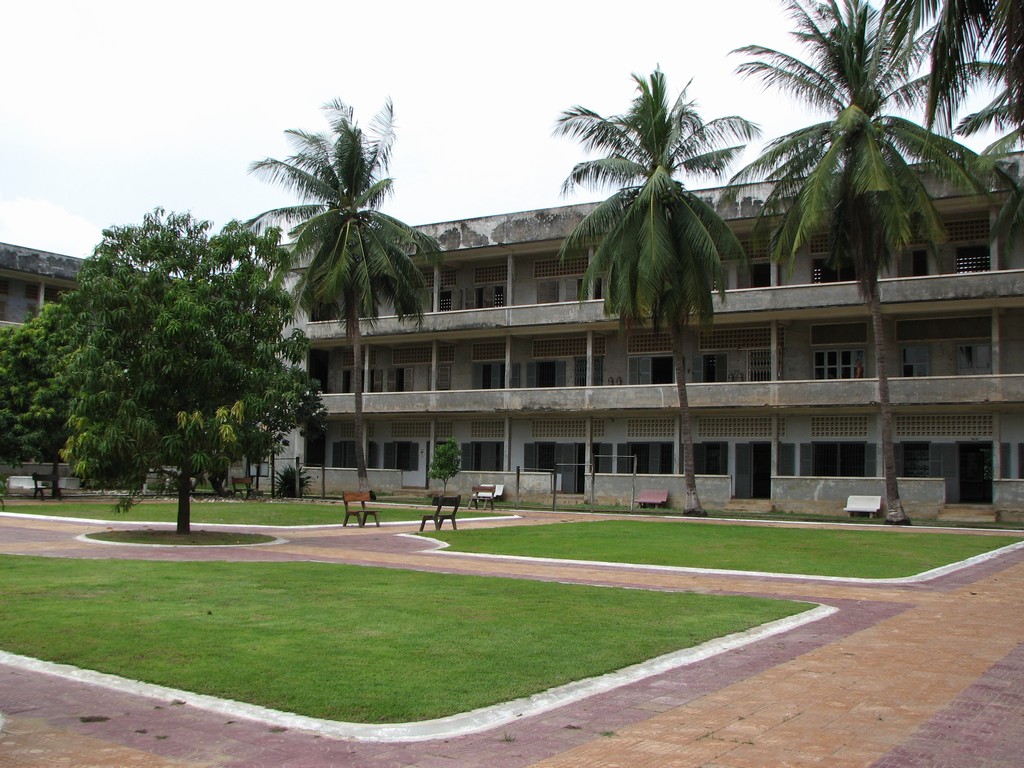


The S-21 Prison In Cambodia
The acronym S-21 stands for Security Office 21, the most secretive and lethal interrogation center operated by the ultra-communist Khmer Rouge regime during their rule over Cambodia (1975–1979).
Housed inside the former Tuol Svay Prey High School in Phnom Penh, it was the administrative nerve center of a vast, paranoid network of nearly 200 prisons scattered across the country. Today, the preserved site is known internationally as the Tuol Sleng Genocide Museum.
The Meaning of S-21
The naming convention of the prison reveals its highly structured, bureaucratic nature:
- The “S”: Stood for the Santebal the dreaded internal state security organization of the Khmer Rouge. The word itself translates to “guardians of the peace,” a deeply ironic title for the regime’s secret police force.
- The “21”: Was the internal, coded radio designation number used by the prison’s high-ranking administration.
A Prison Born of Paranoia
While the fields in rural Cambodia were used to execute everyday citizens, intellectuals, and urban dwellers, S-21 served a more specific, sinister purpose. It was primarily designed to purge the Khmer Rouge’s own ranks.
As Pol Pot’s vision of a radical agricultural utopia began to fail due to mismanagement, starvation, and border conflicts, the regime’s leadership grew deeply paranoid. They became convinced that internal spies, secret CIA agents, and Vietnamese operatives were actively sabotaging the revolution from within.
Consequently, the vast majority of the 15,000 – 20,000 prisoners brought to S-21 were loyal Khmer Rouge cadres, soldiers, military officers, and senior administrators, along with their wives and children, all swept up under a strict policy of “guilt by association.”
The Mechanics of the Compound
S-21 functioned as a processing factory for death. The compound was placed under the command of Kaing Guek Eav, better known as “Comrade Duch”, a former mathematics teacher who ran the facility with ruthless, ledger book precision.
- Stripping of Identity
Upon passing through the heavy gates, prisoners were immediately blindfolded, stripped of their belongings, and assigned a number pinned to their shirts. A mandatory identification photograph was taken of every single inmate. Because numbers were recycled every 12 hours, the administrative staff maintained continuous, meticulously organized logs.
- Systematic Torture
Prisoners were forced into tiny cells built out of rough brick inside former classrooms, chained to iron bars on the concrete floor. They were subjected to intense daily interrogations guided by ten strict prison regulations (e.g., “While getting lashes or electrification you must not cry at all”).
The torturers utilized a horrific array of methods including waterboarding, severe beatings, electric shocks, stripping fingernails, and hanging prisoner upside down from the schoolyard gym gallows to break their subjects mentally and physically.
- Fabricated Confessions
The ultimate goal of S-21 was never justice or truth; guilt was entirely assumed from the moment of arrest. The torture was designed to extract detailed, often entirely fictional, written confessions. Desperate to make the pain stop, prisoners would type out thousands of words falsely admitting to working for foreign intelligence and list dozens of “co-conspirators” their friends, coworkers, and family members who would then be arrested and brought to S-21 to repeat the cycle.
- Mass Execution
Initially, prisoners who succumbed to torture or were ordered for “liquidation” were buried on the school grounds. However, as the prison became overcrowded and the stench of decaying bodies became unbearable to the surrounding neighborhoods, the system changed. Prisoners were loaded onto trucks at night, blindfolded, and driven 15 kilometers south to the orchard of Choeung Ek (The Killing Fields), where they were executed and buried in mass graves.
The Fall and Discovery
When the Vietnamese military entered Phnom Penh on January 7, 1979, the guards and administrators at S-21 fled in extreme haste. Comrade Duch ordered the immediate execution of the remaining prisoners, but the abandonment was so chaotic that the guards failed to destroy the prison’s extensive archives.
Liberating forces discovered a horrifying scene: the bodies of the final 14 victims still chained to iron beds in the interrogation rooms, alongside rooms filled with thousands of negatives, typed confessions, and blood-stained floors.
Among the thousands of inmates who entered S-21, fewer than 15 adults and a handful of children survived. Most survived only because they possessed specific, highly practical skills that Comrade Duch found useful such as Vann Nath (who was spared to paint portraits of Pol Pot) and Bou Meng (who produced propaganda art).
Legacies of Justice
The extensive records left behind at S-21 became the foundational evidence used decades later during the Extraordinary Chambers in the Courts of Cambodia (ECCC) the UN backed Khmer Rouge Tribunal.
In 2010, Comrade Duch became the first high-ranking Khmer Rouge official to be tried and convicted of crimes against humanity and war crimes, ultimately receiving a life sentence behind bars, where he remained until his death in 2020. Today, the photographic negatives and archives of S-21 are protected as part of UNESCO’s Memory of the World Register, serving as an unyielding, permanent historical record to ensure such atrocities are never erased.