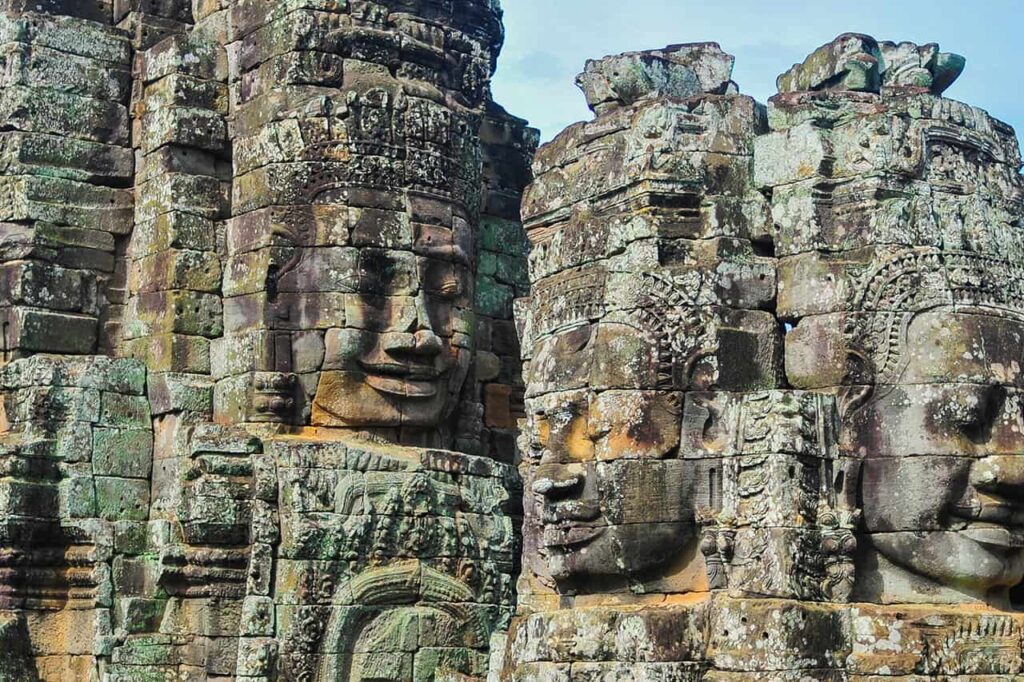


Bayon Temple
Standing at the exact geometric center of the ancient city of Angkor Thom, the Bayon Temple is one of the most enigmatic and visually striking monuments within the Angkor Archaeological Park. Built in the late 12th to early 13th century as the official state temple of King Jayavarman VII, it represents a creative and architectural shift from the classic style of Angkor Wat.
While Angkor Wat impresses with its grand scale and classical proportions, Bayon captivates visitors with its dense, vertical complexity and the mysterious aura of its massive stone faces.
The Smiling Stone Faces
The most defining feature of Bayon is the collection of massive, serene faces carved into the sandstone towers that crowd its upper terrace. When you look up at these towers, you notice a few key details that make them so unique:
- The “Angkor Smile”: Each face features closed eyes and a faint, enigmatic smile, projecting an overwhelming sense of peace and calm compassion.
- Dual Identity: Historians generally agree that the faces represent Avalokiteshvara (the Mahayana Buddhist bodhisattva of compassion). However, because King Jayavarman VII viewed himself as a devaraja (God-king), the features are widely believed to heavily resemble the king himself, blending divine authority with royal portraiture.
- The Multi-Directional Gaze: Most of these towers feature four faces looking out toward the cardinal directions (North, South, East, and West), symbolizing all-seeing protection over the Khmer Empire. While weather and time have worn some down, dozens of these towers remain standing today, creating a labyrinth of eyes that seem to watch visitors from every angle.
Architectural Layout and Evolution
Bayon is uniquely compact and multi-layered, built primarily out of sandstone without the sprawling enclosures seen in other major temples. It is organized into three distinct levels:
- The Lower Terraces (The Outer Galleries): This rectangular base houses some of the most detailed and historical relief carvings in Southeast Asia, focused on the real-world triumphs and daily life of the Khmer people.
- The Upper Terrace: A circular platform that stands in stark contrast to the square lower levels. This area is tightly packed with the iconic face-towers, creating a dense, almost chaotic stone forest that challenges the traditional symmetry of Khmer architecture.
- The Central Sanctuary: A large, circular tower rising from the center of the upper terrace. Originally, it housed a 3.6 meters tall stone statue of the Buddha sheltered by the hood of the serpent king Mucalinda, emphasizing the temple’s Buddhist foundations.
The Bas-Reliefs: A Window into the Khmer Empire
While the stone faces draw your eyes upward, the lower galleries feature remarkably preserved bas-reliefs (shallow carvings) that tell the story of 12th century Cambodia. Unlike many temples that focus strictly on religious myths, Bayon offers an incredible mix of historical epics and everyday life:
- Military Campaigns: Vivid battle scenes on land and water depict the Khmer army complete with war elephants, armor, and commanders engaged in fierce conflicts against the rival Cham Empire (from modern day Vietnam).
- Daily Khmer Life: Tucked beneath the grand military scenes are intimate glimpses into the markets and homes of ancient Angkor. You can find carvings of fishermen throwing nets, women cooking over open fires, lively cockfights, market vendors arguing over prices, and citizens celebrating festivals.
A Quick Tip for Visitors: Because Bayon is relatively compact and its upper terrace gets crowded quickly, the best times to appreciate the play of light on the stone faces are early morning (just after sunrise) or late afternoon. The low angle of the sun deepens the shadows in the carvings, making the famous smiles appear to change expression as the light moves.