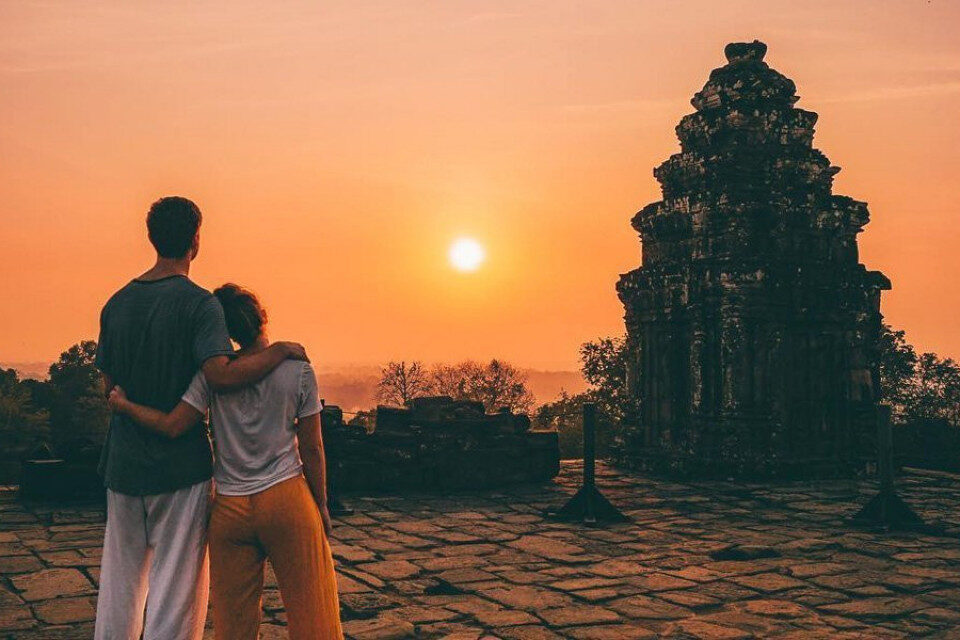


Phnom BaKheng
Let me fetch a visual reference of the temple’s architecture to support the description. Phnom Bakheng is one of the most historically significant and visually striking monuments within the Angkor Archaeological Park in Siem Reap, Cambodia. Constructed more than two centuries before Angkor Wat, it represents a foundational shift in Khmer architecture and geopolitics.
- The Historical Anchor of Angkor
Built at the end of the 9th century (around 889–910 AD) during the reign of King Yasovarman I, Phnom Bakheng was the state temple at the center of a massive new capital city called Yasodharapura.
Prior to this, the Khmer court was situated further southeast at Hariharalaya (the Roluos area). By relocating the capital to the Angkor region and choosing this 65-meter-high natural hill as his symbolic centerpiece, Yasovarman I effectively established the geographic heart of the Khmer Empire for centuries to come.
- Cosmic Symbolism: An Astronomical Calendar in Stone
Phnom Bakheng is a classic temple mountain, structured as a stepped pyramid directly carved from and built upon the natural bedrock of the hill. It was dedicated to the Hindu god Shiva.
The architecture serves as a literal materialization of Hindu cosmology:
- Mount Meru: The steep, seven-level pyramid represents the seven heavens and the mythical mountain home of the gods.
- The Towers: The top platform features five main sandstone sanctuaries arranged in a quincunx pattern (one in the center, four at the corners), representing the five peaks of Mount Meru.
- The Cosmic Calendar: Originally, 108 smaller towers were distributed symmetrically around the base and across the tiers. According to astronomical interpretations, they were positioned so that from the center of any given side, only 33 towers are visible simultaneously the exact number of gods in the Hindu pantheon who dwell on Mount Meru. The total number of 108 also mathematically aligns with the four lunar phases (27 days each).
Over the centuries, the site shifted from Hindu worship to Theravada Buddhism. In the 16th century, efforts were even made to build a massive stone Buddha around the central towers, fragments of which can still be traced in the ruins.
- The Modern Experience: The Sunset & Sunrise Spectacle
Today, Phnom Bakheng is celebrated globally for its panoramic view. Standing on the upper terrace provides a 360-degree vista over the surrounding jungle canopy:
- To the Southeast: You can view the distinctive five towers of Angkor Wat rising from the trees roughly 1.5 kilometers away.
- To the West: It overlooks the expansive waters of the Western Baray.
Because of these unobstructed views, it has become the most iconic location in Siem Reap to watch the sunset, as the fading light turns the ancient sandstone golden.
Visitor Note: To protect the structural integrity of the monument from heavy foot traffic, the APSARA National Authority and the World Monuments Fund (which has led extensive restoration projects here since 2004) maintain a strict 300-person limit on the top platform at any one time. Travelers looking to catch the sunset often aim to arrive by 4:00 PM to secure a spot before the cutoff.
Getting to the temple requires a moderate, scenic 15 to 20-minute walk up a winding jungle path wrapping around the hill, followed by a final climb up steep, preserved stone staircases.