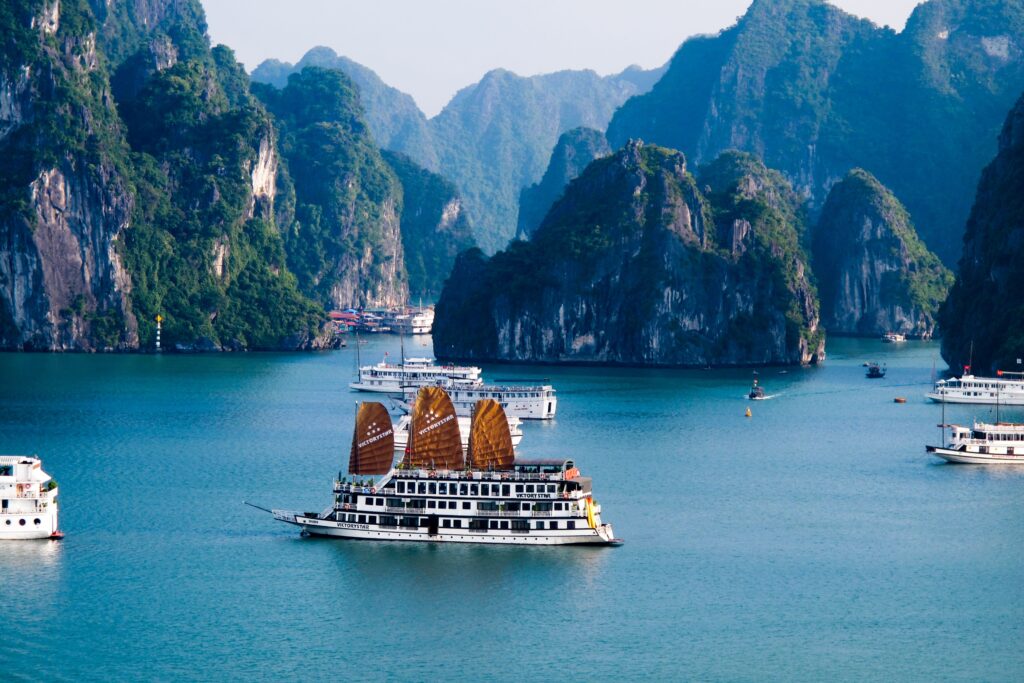


Ha Long Bay
Ha Long Bay, a UNESCO World Heritage Site, remains Northern Vietnam’s premier luxury tourism asset. Strategically, the region is categorized into three distinct geographical bodies of water: Ha Long Bay Proper (The Classic Core), Lan Ha Bay (The Premium/Adventure Extension), and Bai Tu Long Bay (The Pristine/Exclusive Sector).
For professional B2B itinerary planning, high-end corporate retreats, or sophisticated leisure routing, the following breakdown highlights the critical tourist hot spots across these sectors.
- The Classic Core (Ha Long Bay Proper)
This sector contains the most iconic, globally recognized karst formations and high-capacity caverns. It is the primary corridor for day cruises and traditional 2-Day, 1-Night (2D1N) itineraries departing from Tuan Chau International Marina or Sun World Port.
- Sửng Sốt Cave (Surprise Cave): Located on Bo Hon Island, this is the largest and most commercially significant cave in the bay, spanning over 10,000 square meters. Its two massive chambers feature sophisticated interior lighting that accentuates thousands of ancient stalactites and stalagmites. Planning Note: The cave requires an uphill climb and features a fixed, high-volume one-way walking path, making it less suitable for clients with mobility limitations.
- Ti Top Island: Renowned for its panoramic geometry, Ti Top features a crescent-shaped white sand beach at its base and a steep, 400-step stone staircase leading to a summit pavilion. It offers the most celebrated 360-degree aerial view of the central bay.
- Luồn Cave: A prime location for marine recreation. This low-ceilinged, 60-meter-long water grotto can only be passed through via kayak or local bamboo woven boats at low-to-medium tide, leading into a serene, cliff-enclosed tidal lagoon home to wild macaque troops.
- Hòn Gà Chọi (Fighting Cock Islet): Standing roughly 12 meters above the water line, these two interlocking karsts resemble a pair of fighting cockerels. It serves as the official visual symbol of Ha Long Bay and is an essential photography waypoint on all standard day-cruise channels.
- The Premium Eco-Sector (Lan Ha Bay & Cat Ba Archipelago)
Geographically located south of Ha Long proper around Cat Ba Island, Lan Ha Bay shares the same dramatic limestone topography but operates with significantly lower vessel density. It is highly favored by ultra-luxury boutique brands and modern superyacht-style operators focusing on wellness and uncrowded waters.
- Ao Ếch (Frog Lagoon) & Dark & Bright Cave (Hang Tối Sáng): Ao Ech is a highly sheltered, emerald-water basin ideal for swimming and deep-bay kayaking. Nearby, the Dark and Bright Cave system provides a spectacular transition from the open sea into a silent, hidden lake crater through a dramatic 100-meter limestone tunnel.
- Ba Trái Đào Beach (Three Peaches): A cluster of three small, rounded karsts enclosing a collection of pristine, secluded sandbars. Because these beaches are heavily tide-dependent and shielded from strong winds, they are frequently utilized by premium cruises for exclusive beach setups, swimming, and private tender drop-offs.
- Việt Hải Village: Tucked away in a valley within Cat Ba National Park, this isolated, eco-conscious village is a major anchor for extended 3-Day, 2-Night (3D2N) luxury itineraries. Guests disembark to bicycle or take electric carts down a scenic jungle tunnel road to observe traditional northern agricultural life, local herbal distilleries, and eco-trekking paths.
- The Remote Serenity Sector (Bái Tử Long Bay)
Positioned to the northeast, Bai Tu Long occupies three-quarters of the total World Heritage area but hosts only a fraction of the cruise permits. It is tailored specifically for off-the-beaten-path expeditions, ultra-luxury charters, and clients prioritizing deep privacy.
- Vung Vieng Floating Fishing Village: A culturally rich, historical community where generations of fishermen lived in floating houses. While the residents have been largely relocated landside for conservation, the infrastructure remains as a living museum of pearl farming and sustainable marine cultivation, accessed via traditional rowing boats.
- Thiên Cảnh Sơn Cave: A beautifully preserved, less-frequented cavern located on Hon Co Island. It features a moderately challenging forest trail leading to a hidden upper chamber filled with delicate stalactite formations, concluding with a scenic overlook of the untouched eastern bay.
- 4. Landside & Entertainment Anchors (Ha Long City)
For itineraries requiring pre- or post-cruise land stays, Ha Long City has developed world-class hospitality and entertainment infrastructure.
- The Quang Ninh Museum (Bảo tàng Quảng Ninh): Designed by Spanish architect Salvador Perez Arroyo, this striking, coal-black glass structure sits prominently on the coastal road. It houses world-class exhibits detailing the region’s geological evolution, ancient maritime trade, coal mining history, and ethnic minority cultures.
- Sun World Ha Long Complex: A massive dual-zone amusement hub. It features a coastal beach park connected via the record-breaking Queen Cable Car (spanning across the Cua Luc Strait) to the Mystic Mountain complex on Ba Deo Hill, which features a giant Ferris wheel, Japanese Zen gardens, and elite corporate event venues.
Operational Dynamics: Selecting the correct cruise line is entirely dependent on the desired route. Standard itineraries (Route 1 and 2) focus heavily on Ha Long proper’s major sights but encounter high seasonal crowds. Premium wellness and lifestyle vessels increasingly utilize the southern corridors toward Lan Ha Bay to offer private balconies, floor-to-ceiling glass design, and expansive open-deck spaces without visual obstruction from competing fleets.