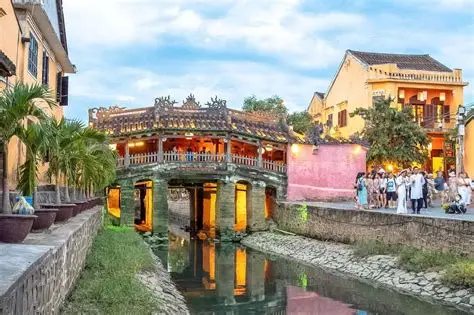


Hoi An Ancient Town
Hoi An Ancient Town is one of Southeast Asia’s most exceptionally preserved gems. Located in central Vietnam’s Quang Nam Province along the banks of the Thu Bon River, this UNESCO World Heritage Site is a striking architectural time capsule.
Between the 15th and 19th centuries, Hoi An (then known to Western merchants as Faifo) operated as a major international trading port. Because economic activity shifted north to Da Nang in the late 19th century, Hoi An was left largely untouched by modern development. Today, it stands as a living museum of over 1,000 remarkably preserved heritage structures.
The Cultural Fusion of Architecture
What makes Hoi An uniquely fascinating is its architectural blend. As a bustling maritime hub, it welcomed waves of merchants who settled down and left permanent cultural marks on the townscape.
- The Yellow “Tube” Houses: The town is famous for its narrow, deep “tube houses” painted a distinct, warm mustard yellow. Their design cleverly maximizes street frontage for businesses while stretching far back into private living spaces.
- The Central Skylights: Because these houses are incredibly deep and packed side-by-side, they feature open-air internal courtyards (skylights). These light wells allow natural ventilation, rainwater drainage, and sunlight to pierce the dark, completely wooden interiors.
- A Cross-Cultural Mix: Walking through the town reveals a harmonious blend of styles. You will see traditional Vietnamese open-beam wooden frames, Chinese calligraphic plaques and tiled assembly halls, Japanese structural joints, and French colonial shutters.
Key Landmarks to Explore
To protect the fragile structural integrity of the old town, the historic center is a designated pedestrian and bicycle-only zone during peak hours of the day.
- The Japanese Covered Bridge (Chùa Cầu)
Dating back to the late 16th to early 17th century, this beautiful arched, wooden bridge was built by the local Japanese merchant community to link their quarter with the Chinese neighborhood across the canal. It features a unique weathered tile roof and houses a small temple inside dedicated to weather deities.
- 2. Tan Ky Old House
Built in 1741, this magnificent merchant home has been lovingly preserved by seven generations of the same family. It is a prime example of a multi-component architectural style, structurally combining a Japanese-influenced wooden ceiling frame with intricate Chinese poem panels inlaid with mother-of-pearl.
- Fujian Assembly Hall (Hội Quán Phước Kiến)
Originally constructed as a traditional social and religious gathering hub for Chinese traders from Fujian, this complex features a grand triple-gated entrance adorned with colorful porcelain tilework. Inside, its main sanctuary is dedicated to Thien Hau, the goddess of the sea who protects sailors and merchants.
The Living Heritage Experence
Highlight | What Makes It Special |
The Lantern Festival | Every evening, the town replaces harsh electric lights with the soft, magical glow of thousands of handmade silk lanterns. Visitors can take traditional wooden boats along the Hoai River to release small paper lanterns onto the water. |
Master Tailoring | Carrying on its historic legacy as a key maritime silk route trade stop, Hoi An is a global hotspot for custom apparel. Dozens of highly skilled local tailor shops can craft bespoke suits, dresses, and leather shoes within 24 to 48 hours. |
Unique Local Flavors | Because of its distinct cultural history, Hoi An boasts an exclusive culinary scene. Its signature dish is Cao Lau—thick, chewy rice noodles topped with sliced pork and fresh herbs, traditionally made using alkaline water drawn from secret, ancient local wells. |