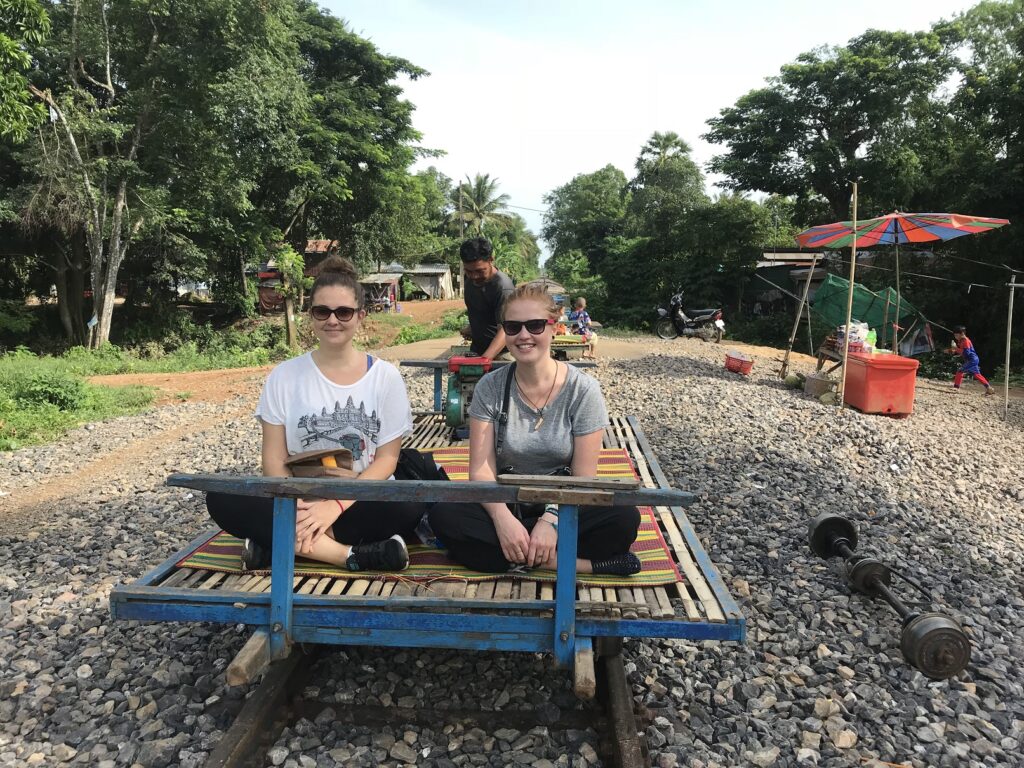


The Bamboo Train In Cambodia
One of the most unique, improvised, and downright fun travel experiences in Southeast Asia is the Bamboo Train of Battambang. Known locally in Khmer as a norry (derived from the French word lorry), this is a masterpiece of necessity engineering born out of Cambodia’s turbulent history.
It isn’t a traditional train at all it’s a minimalist, open-air flying carpet of bamboo and steel that zips through the Cambodian countryside just inches above the rails.
The Origin: Improvised Brilliance
To understand the norry, you have to look back to the 1980s. Following the devastation of the Khmer Rouge regime, Cambodia’s official rail infrastructure was left completely shattered. The tracks built during the French colonial era were warped, overgrown, and entirely abandoned by standard trains.
Rural communities were isolated, and roads were in terrible condition. Local railway workers realized they could use the old, damaged tracks to move people, medical supplies, harvested rice, and livestock. They scavenged old steel wheels left behind by the French and built a brilliantly simple vehicle:
1.The Undercarriage: Step 1.
Two independent, heavy steel axles fitted with train wheels are placed directly onto the rails.
2.The Platform: Step 2.
A lightweight, removable 3-meter flatbed woven from split bamboo slats on a wooden frame is lifted and laid loosely right on top of the axles.
3.The Motor: Step 3.
A small, multi-purpose gasoline engine (usually a small tractor, lawnmower, or boat engine) is mounted at the rear. A simple rubber fan belt connects the engine directly to the rear axle.
To make it move, the driver simply pulls a starter cord and uses a wooden pole as a lever to tension the belt against the axle, sending the norry clattering down the line at speeds of up to 40–50 km/h.
The Rule of the Rail: The Ultimate Breakdown
Because the entire network consists of a single track, trains running in opposite directions inevitably meet head on. Without any digital signaling or passing loops, the drivers rely on an unwritten, decades old etiquette to solve the problem.
When two norries meet, the rule is simple: the train with the lighter load must yield.
How it works: Both drivers jump off. The passengers disembark. In less than sixty seconds, the drivers lift off the bamboo platform, remove the steel axles from the tracks, and set them in the grass. The heavier train drives past, and then the drivers quickly reassemble the lighter train back on the rails so everyone can continue their journey.
The Modern Experience & The Two Distinct Lines
As Cambodia’s national rail lines have been modernized and rebuilt for real passenger trains running between Phnom Penh and the Thai border, the norry has shifted from a vital piece of public transit to a legendary tourist attraction.
Today, if you visit Battambang, you will find two different bamboo train locations, each offering a slightly different vibe:
- The Original O Dambong Line (The Adventurous Route)
Located about 5 km outside of Battambang city center, this route utilizes a segment of the historic railway line. It is famous for being incredibly bumpy, loud, and thrilling. The rails are old and warped, meaning you will feel every single joint and dip in the track. It takes you on a round-trip through local brush and rice fields to a small village housing an old brick factory before heading back.
- The New Banan Line (The Scenic Route)
Opened to protect the tradition when the main lines began renovations, this custom tourist track sits around 20 km south of the city near the base of the ancient Phnom Banan temple. The tracks here are freshly laid, straight, and smooth, offering a much gentler ride through beautiful mountain view scenery. It ends at a leisure garden with a built-in turntable, meaning the drivers don’t have to manually flip the cars around for the return trip.
Essential Tips for the Ride
- Bring a Cushion or Sarong: The bamboo slats are hard, and the classic tracks are intensely bumpy. Sitting on something soft will save your tailbone.
- Protect Your Eyes: There is no windshield or roof. Dust, stray twigs, and bugs can fly at your face, so a pair of sunglasses and a scarf are highly recommended.
- Golden Hour Magic: Catching a ride in the late afternoon (around 16:00 PM) offers incredible light for photographing the surrounding rice paddies and rural life as the sun begins to dip.