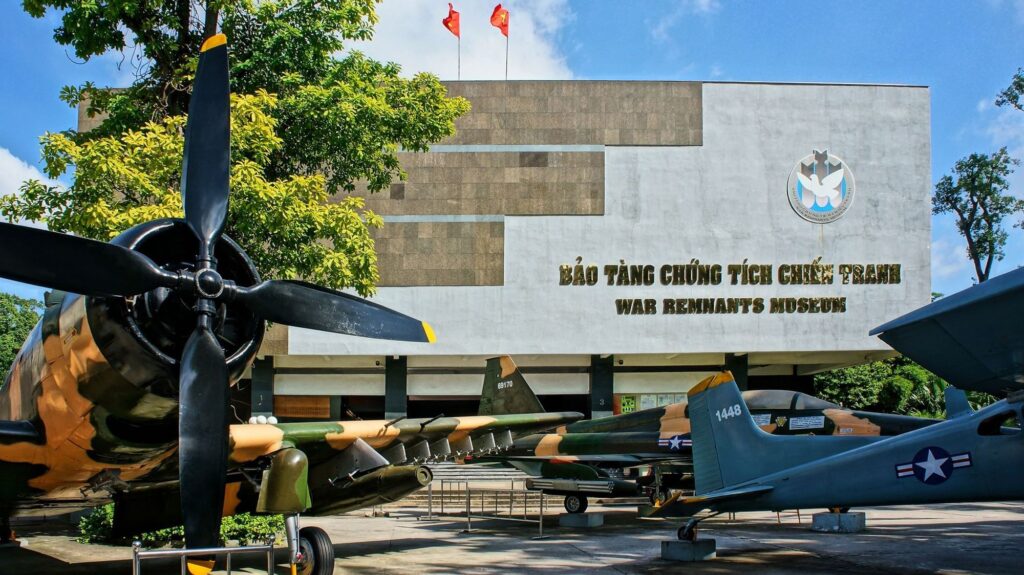


The War Remnants Museum (Bảo tàng Chứng tích Chiến tranh) in Ho Chi Minh City’s District 3 is one of the most visited, emotionally heavy, and profoundly moving museums in Southeast Asia.
Rather than focusing on tactical military triumphs, the museum centers on the human cost, raw realities, and long-lasting civilian trauma of the Vietnam War (known locally as the Resistance War Against America). It is a central member of the International Network of Museums for Peace, intending to serve as a stark reminder of the atrocities of war to advocate for global peace.
The Evolution of a Narrative
Opened just months after the end of the war in September 1975, the institution was originally named the Exhibition House for U.S. and Puppet Crimes.
As Vietnam began normalizing diplomatic ties with the West in the 1990s, the name was changed first to the Exhibition House for War Crimes and finally, in 1995, to the War Remnants Museum. While the tone was modified to reflect a spirit of reconciliation, the core exhibits remain unfiltered, uncompromising, and deeply impactful.
Layout of the Museum and Key Exhibits
The museum is split between an outdoor courtyard of captured military hardware and a three-story main building housing highly detailed, themed photographic galleries.
The Courtyard: Heavy Armor and Airpower
Before entering the building, you walk through a display of captured American military aircraft, heavy artillery, and armored vehicles. These massive machines underscore the staggering technological asymmetry of the conflict. Key pieces include:
- A UH-1 “Huey” helicopter, the ubiquitous symbol of American troop transport during the war.
- An M48 Patton tank and heavy M113 armored personnel carriers.
- A-1 Skyraider and F-5A fighter jets, alongside unexploded block bombs and heavy artillery pieces arranged across the front pavement.
Indoor Galleries: The Human Cost
The interior galleries hold over 20,000 documents, artifacts, and photographs. The upper levels contain the most emotionally challenging material.
- The Agent Orange Exhibition (2nd Floor)
For many visitors, this is the most devastating room in the museum. It documents the catastrophic, multi-generational impact of the dioxin chemical defoliants sprayed over millions of acres of Vietnamese jungle by the U.S. military. Through a collection of medical records, harrowing documentary photographs (many by Japanese photojournalist Goro Nakamura), and personal letters, it traces how the toxic chemical altered ecosystems and caused severe birth defects that continue to afflict families down to the third and fourth generations.
- The Requiem Collection (3rd Floor)
This incredibly moving photojournalism gallery features work compiled by legendary photographers Tim Page and Horst Faas. It displays pieces from 133 photographers of various nationalities—including American, North Vietnamese, South Vietnamese, French, and Japanese—who were killed in action covering the front lines. It showcases the war through the eyes of the people who died trying to document its reality, emphasizing shared humanity and vulnerability amidst chaos.
- Aggression War Crimes (2nd Floor)
This section charts specific military operations, civilian massacres (such as the tragic events at My Lai), and the devastating effects of widespread aerial bombing campaigns. The imagery here is graphic and starkly portrays the physical destruction inflicted upon unarmed communities.
The Con Dao “Tiger Cages” Replicas
In a separate courtyard corner stands a chilling, life-sized replica of the political prisons from Con Dao Island and Phu Quoc Island.
It details the brutal treatment of revolutionary prisoners under colonial and wartime regimes, featuring the notorious “tiger cages”—cramped, barbed-wire topped concrete cells where prisoners were kept in darkness, exposed to the elements, and subjected to severe mistreatment.