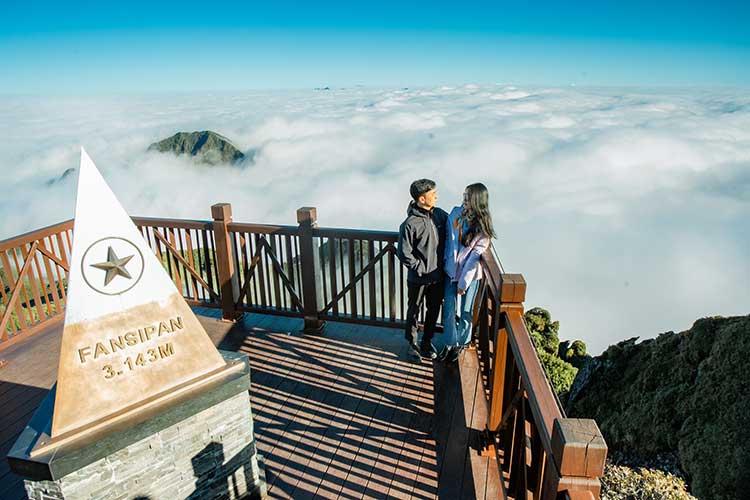


Fansipan Mountain
Fansipan mountain (Phan Xi Păng), located in Lao Cai Province in northwestern Vietnam, stands as the highest peak in the Indochinese Peninsula. Rising to an elevation of 3,147.3 meters (10,326 feet), it is widely referred to as the “Roof of Indochina.”
As a geographical landmark and an economic cornerstone of regional tourism, Fansipan is situated within the Hoang Lien Son mountain range the southeastern extension of the Himalayas.
- 1. Geological and Environmental Overview
The Hoang Lien Son range was formed approximately 250 million years ago during the Indosinian orogeny (mountain-building event). Fansipan itself is composed primarily of ancient granite formations and complex metamorphic rock layers.
Biodiversity
The mountain acts as a vital ecological sanctuary protected by the Hoang Lien National Park. It features distinct microclimates stratified by altitude, giving rise to exceptional biodiversity:
- Subtropical Zones (below 2,000 meters): Dominated by dense broadleaf evergreen forests, rich in valuable timber and medicinal herbs.
- Temperate Zones (2,000 to 2,800 meters): Characterized by gymnosperms, particularly specialized conifers, and over 20 distinct species of native rhododendrons (azaleas) that bloom intensely from March to May.
- Subalpine Alpine Zones (above 2,800 meters): Dominated by dwarf bamboo (Phyllostachys) and alpine scrub capable of surviving high-velocity winds and low temperatures.
Climate Character
Fansipan experiences a humid subtropical to subalpine climate depending entirely on elevation. At the summit, temperatures drop significantly, with sub-zero Celsius temperatures recorded during the winter months (December to February), occasionally bringing frost and rare snowfall events to equatorial Southeast Asia.
- 2. Infrastructure & The Engineering Achievement
Historically, reaching the summit required a grueling, multi-day technical trek. The operational landscape changed permanently in February 2016 with the inauguration of the Fansipan cable car system, developed by Sun Group (Sun World Fansipan Legend).
The Three-Wire Cable Car System
The system holds multiple Guinness World Records due to its complex engineering across extreme mountain terrain:
- Technology: A three-wire (tricable) detachable gondola system engineered by the Swiss-Austrian firm Doppelmayr Garaventa. This configuration ensures maximum aerodynamic stability against high winds.
- Span and Ascent: The cable car covers a horizontal length of 6,292.5 meters, achieving a vertical rise of 1,410 meters in just 15 minutes.
- Capacity: Each spacious cabin can accommodate up to 35 passengers, vastly scaling the logistical capacity of the Sapa tourism corridor.
Peak Infrastructure
The upper station links to a highly developed spiritual and commercial complex. For visitors opting out of the final 600-stone staircase climb to the pinnacle, the Muong Hoa funicular railway provides a direct mechanical link from the station to the peak area.
- The Spiritual and Architectural Complex
The upper slopes of Fansipan host a monumental complex designed in the architectural style of traditional 15th-century Vietnamese Buddhist temples (specifically reflecting the Le Dynasty). Constructed under intense weather conditions, the structures are built using natural stone, bronze, and seasoned ironwood.
Key Architectural Landmarks
- The Great Buddha Statue: Standing at 21.5 meters tall, it is the highest bronze Buddha statue in Vietnam, cast from over 50 tones of bronze using advanced reinforcement techniques to withstand sub-alpine wind shears.
- Kim Son Bao Thang Pagoda: A classical temple complex featuring a 11-story stone stupa, built perfectly into the natural crags of the mountain ridge.
- The Avalokitesvara (Quan Am) Statue: A prominent bronze figure facing the sweeping mountain valleys.
- Tourism and Trekking Operations
From a destination management perspective, Fansipan caters to two distinct market segments:
Leisure and MICE Tourism
Leveraging the cable car network, the site serves as a high-volume, accessible destination. It seamlessly handles domestic and international corporate tours, luxury travelers, and multi-generational families who stay in Sapa and visit the summit within a half-day itinerary.
Adventure Tourism (Trekking)
Despite mechanical access, the classic overland routes remain highly sought-after by adventure travelers. All treks require registered local guides (primarily from the local Black H’mong and Red Dao ethnic minorities) and national park permits.
Route | Duration | Technicality & Terrain |
Tram Ton Pass | 1 to 2 Days | The standard, most accessible route. Starts at 1,900m. Focuses on well-established dirt paths and metal ladders. |
Sin Chai Village | 2 to 3 Days | High technicality. Demands steep scrambling and navigation through deep bamboo thickets with significant elevation changes. |
Cat Cat Village | 3 Days | The longest, most physically demanding route. Offers the deepest exposure to the diverse forest ecosystems and valleys of the range. |
- Regional Economic Impact
Fansipan operates as the ultimate anchor attraction for Lao Cai Province. Its development has shifted Sapa from a seasonal, backpacker-dominated mountain outpost to an international year-round destination. This rapid growth continues to drive high-yield infrastructure investments, including international five-star luxury hotels and expanded regional highway connectivity to Hanoi.