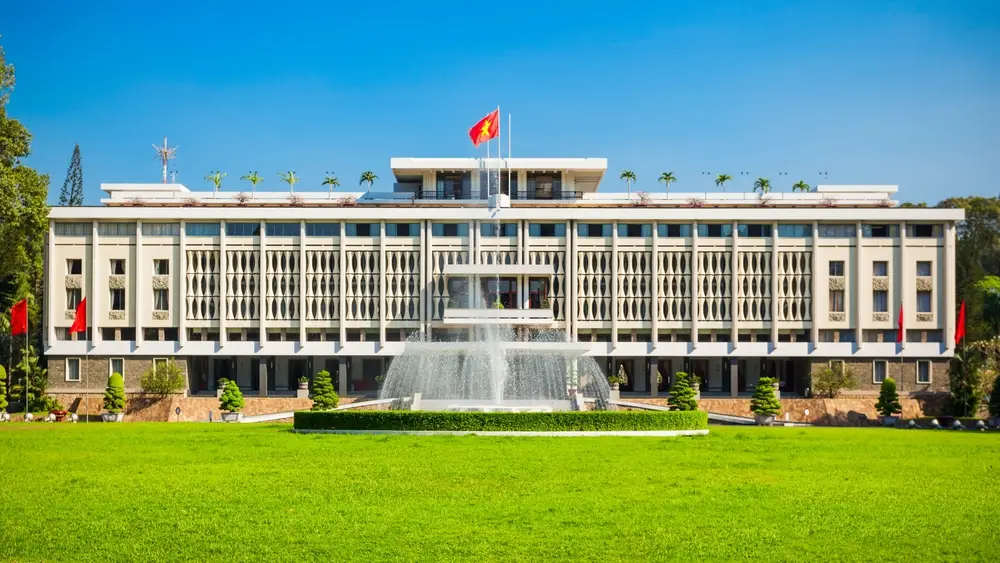


Independence Palace
The Independence Palace (also famously known as the Reunification Palace or Dinh Độc Lập) is one of the most culturally and historically significant landmarks in Ho Chi Minh City. Sitting on a lush 12-hectare plot in the heart of District 1, it is a fascinating time capsule where 1960s modernist architecture meets the dramatic conclusion of the Vietnam.
A Tale of Two Palaces: The History
The site has undergone several transformations, mirroring the shifting tides of Vietnam’s modern history:
- The Colonial Era (Norodom Palace): In 1868, the French colonial government built a grand, neo-Baroque palace on this site called Norodom Palace, which served as the residence for the Governor-General of Cochinchina.
- The 1962 Bombing & Rebirth: In 1954, South Vietnamese President Ngo Dinh Diem took over the residence and renamed it the Independence Palace. However, in 1962, two dissident South Vietnamese air force pilots bombed the palace in an attempt to assassinate him. The structure was so badly damaged that Diem ordered it demolished and commissioned a completely new, modern replacement.
- The Modernist Masterpiece: The building you see today was designed by the celebrated Vietnamese architect Ngo Viet Thu (the first Vietnamese winner of the prestigious Grand Prix de Rome). Construction began in 1962 and was completed in 1966. Ironically, President Diem never lived to see its completion; he was assassinated during a coup in 1963. Instead, it became the home and workplace of subsequent South Vietnamese President Nguyen Van Thieu.
The Defining Moment: April 30, 1975
The palace is globally famous for being the exact setting where the Vietnam War came to an end. On the morning of April 30, 1975, North Vietnamese army tanks (specifically Tank 843 and Tank 390) crashed through the wrought-iron front gates of the palace.
A soldier ran up to the balcony to unfurl the National Liberation Front flag, signaling the Fall of Saigon and the reunification of the country. Today, two replica tanks sit on the manicured front lawns to commemorate that exact historic turning point.
Architecture & Design: A Modernist Time Capsule
Architect Ngo Viet Thu brilliantly blended mid-century modern Western functionalism with classical Eastern philosophy. From the outside, the layout of the concrete facade subtly forms the shape of several Chinese characters representing attributes like “Prosperity” (Cat) and “Freedom” (Tự). The building is remarkably airy, utilizing vertical concrete louvers that mimic bamboo breaks to shield the interior from the tropical sun while allowing natural breezes to pass through.
Inside, walking through the corridors feels like stepping back into a 1960s or 1970s film set—everything from the shag carpets to the vintage drapes has been meticulously preserved.
Key Areas to Explore:
- The Grand State Rooms (1st & 2nd Floors): These expansive, opulent rooms feature massive chandeliers, golden curtains, and lacquered artwork. They include the Cabinet Room, the Banquet Hall, and the Ambassador Chamber, where foreign dignitaries presented their credentials.
- The President’s Living Quarters (3rd Floor): A glimpse into the private life of leadership, including a vintage cinema room, an American-inspired card-playing lounge with a circular leather banquette, and a private rooftop nightclub area.
- The Rooftop Helipad (4th Floor): Where a replica Bell UH-1 Huey helicopter sits on the tarmac, marking the final, frantic evacuation route used by American and South Vietnamese officials as the city fell.
- The Underground War Bunker (Basement): For many, this is the most fascinating section. Descending into the windowless basement reveals a tactical command center built to withstand heavy bombing. It remains frozen in time with its map rooms, original telecommunications equipment, wall-mounted rotaries, and old radio transmitters.