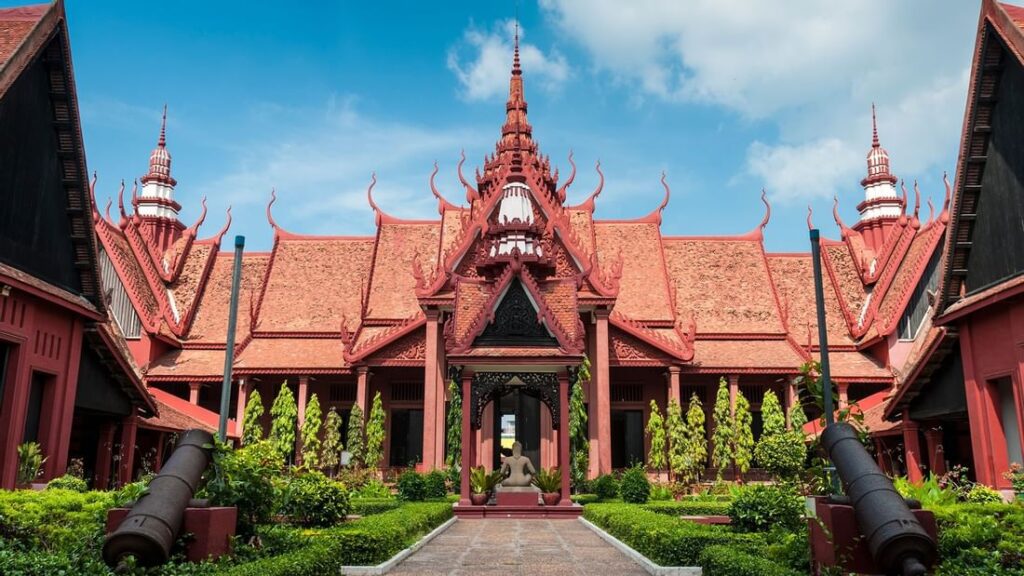


National Museum In Cambodia
Located just north of the Royal Palace in Phnom Penh, the National Museum of Cambodia is the country’s premier historical and archaeological museum. It houses one of the world’s largest and most magnificent collections of Khmer art including masterworks of sculpture, ceramics, bronzes, and ethnographic objects that span from prehistoric times through the glory days of the Angkor Empire to the modern era.
While places like Angkor Wat allow you to see ancient architecture in situ, the National Museum is where you go to look the gods, kings, and history of the Khmer Empire directly in the eye.
The Architecture: A Colonial Khmer Hybrid
The building housing the museum is a work of art in its own right. Designed by French historian, curator, and architect George Groslier, construction took place between 1917 and 1920 during the French colonial era.
Groslier designed the building by scaling up traditional Cambodian temple prototypes found on ancient temple bas-reliefs. The design blends classic Khmer motifs with colonial utility:
- The Terracotta Facade: The exterior is painted a deep, rich dark-red terracotta color that glows brilliantly during the late afternoon sun.
- The Tiered Roofs: The building features soaring, high gabled roofs adorned with ornamental, upturned chofa (slender roof finials resembling temple guardians) and central spires.
- The Hidden Courtyard: The four main wings of the museum surround a lush, peaceful open-air inner courtyard. This central garden features four tranquil lotus ponds, manicured greenery, and a small, elegant pavilion housing a sacred statue of the Buddha, providing a quiet place for visitors to rest between galleries.
A Journey Through Time: The Core Galleries
The museum’s interior layout is organized chronologically into a giant rectangle around the central courtyard. It guides you seamlessly through four main eras of Cambodian history, cataloged across over 14,000 preserved artifacts:
- Prehistoric Era
This gallery showcases daily life in Cambodia during the Stone, Bronze, and Iron ages. It contains ancient stone tools, pottery, human remains, and beautifully preserved bronze jewelry and decorative artifacts discovered at key archaeological sites like Samrong Sen and Memot.
- 2. Pre-Angkorian Era (5th to 8th Centuries)
This section tracks the early evolution of Khmer art during the Funan and Chenla empires. The sculptures here show a strong Indian religious influence (Hinduism and Buddhism practicing side by side) but reveal the exact moments Khmer artisans began developing a completely distinct, original style.
- The Highlight: Look for the famous Harihara statues extraordinary sculptures depicting a deity that is half-Shiva (the destroyer) and half Vishnu (the preserver), split down the exact center of the stone.
- 3. Angkorian Era (9th to 14th Centuries)
The absolute crown jewel of the collection. This gallery holds massive sandstone statues recovered directly from the temple complexes of Angkor Wat, Koh Ker, and the Bayon.
The Masterpiece to Look For: The museum houses the legendary, life sized sandstone statue of King Jayavarman VII. He is depicted sitting cross legged in deep, serene meditation. The absolute calm and gentle smile on his stone face is the exact visual definition of the “Angkor Smile” found throughout Bayon.
- Post-Angkorian Era (15th Century to Mid-20th Century)
Following the shift of the capital south toward Phnom Penh, Khmer craftsmanship evolved. This gallery features delicately carved wooden Buddha statues, items adorned with mother of pearl and ivory, royal transport palanquins, and traditional textiles.
The Bronze and Conservation Workshops
The museum also features a world-renowned Bronze Gallery, detailing the complex lost-wax casting methods utilized by ancient Khmer metalsmiths to forge intricate statues of mythical beasts like the Garuda, weapons, and temple bells.
A prized exhibit here is the monumental fragment of a reclining Vishnu made of bronze, recovered from the West Mebon Temple in Angkor. Even as a partial fragment consisting of the head and upper torso, it stands as a testament to the staggering scale of ancient Khmer metallurgy.
Visitor Details for Planning:
- Hours: Open daily from 8:00 AM to 5:00 PM.
- Photography: You are completely free to take photos outside in the central lotus courtyard, but photography is strictly prohibited inside the main indoor art galleries to protect the ancient pigments and materials.
- Location: Conveniently positioned right on Street 13, making it an easy, seamless pairing with a morning walk through the adjacent Royal Palace grounds.