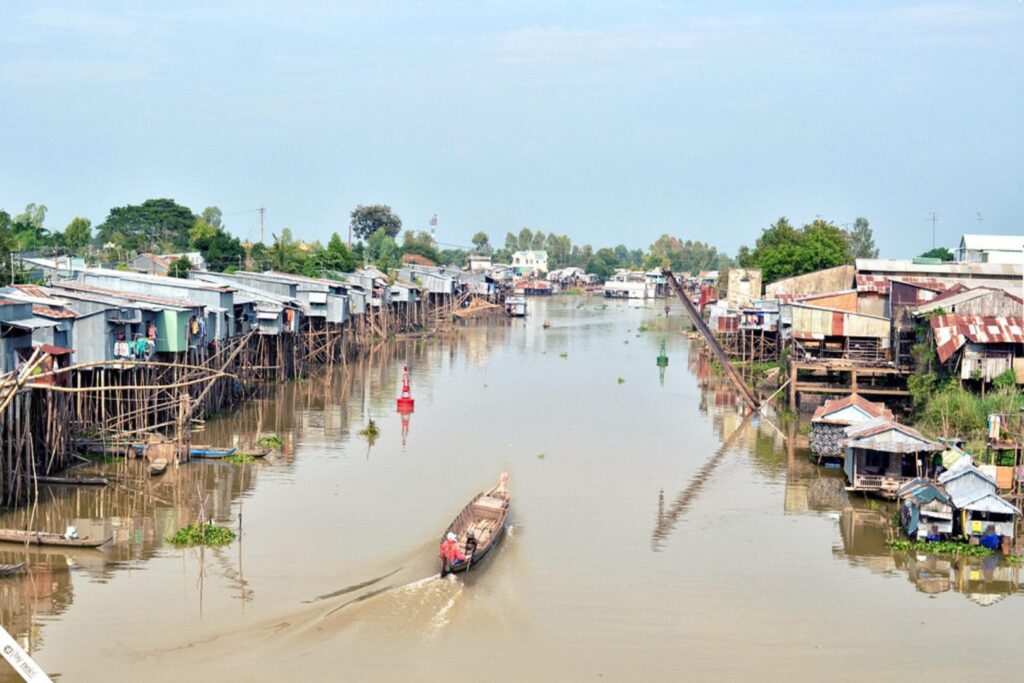


Vinh Te Canal
The Vinh Te Canal is one of the most significant monumental engineering feats in the history of southern Vietnam. Stretching roughly 87 kilometers, this hand-dug waterway runs almost parallel to the Cambodia-Vietnam border, serving as a vital link for transportation, agriculture, and regional logistics for over two centuries.
- Geography & Route
The canal acts as a massive cross-regional artery in the Mekong Delta, connecting the Basac River (a primary branch of the Mekong) to the Gulf of Thailand.
- Starting Point: Chau Doc (An Giang Province)
- Ending Point: Ha Tien (Kien Giang Province)
- Dimensions: Approximately 87 km long, initially cleared to a width of about 30 meters and a depth of roughly 2.5 meters.
By slicing directly across the flat, marshy floodplains of the Long Xuyen Quadrangle, it creates a direct inland waterway to the coast, bypassing the need to navigate out through the open river mouths of the Mekong Delta and around the peninsula.
- Historical Origin & Construction
The construction of the canal was a massive, high-stakes project commissioned during the Nguyen Dynasty.
- The Timeline: Begun in late 1819 under Emperor Gia Long and completed in 1824 under Emperor Minh Mang.
- The Leadership: The project was managed and overseen by the famous general and administrator Thoai Ngoc Hau (Nguyen Van Thoai).
- The Labor: It is estimated that tens of thousands of Vietnamese and Cambodian laborers worked on the project. Digging 87 kilometers of earth entirely by hand through dense jungle, swampland, and harsh terrain was an immense challenge, resulting in high casualties due to disease, exhaustion, and wild animals.
What’s in a Name? Emperor Minh Mang officially named the canal Vinh Te to honor Chau Thi Te, the wife of Thoai Ngoc Hau, recognizing her critical supportive role in managing logistics and labor relations during its grueling construction.
- Strategic & Modern Significance
Historically built for border defense and to assert administrative control over the remote western delta, the canal completely transformed the region’s landscape.
- Agricultural Lifeline: It acts as a massive drainage and irrigation network. Every year during the flooding season, the canal helps channel excess water away from the Mekong, while introducing fresh water and nutrient-rich silt to wash away the acidity of the surrounding soil, turning millions of hectares into highly productive farmland.
- Trade and Logistics Corridor: For generations, the Vinh Te Canal has been a bustling transport corridor. It allows local goods, agricultural produce, and fisheries to move seamlessly from inland river hubs like Chau Doc directly to coastal ports in Kien Giang, facilitating smooth cross-border trade and local economic integration.